

- 9 July 2026
- The Neuro-Concept Blog
Gait Disorders: Understanding, Assessing, and Rehabilitating to Regain Independence
By Dre Murielle Grangeon, PhD, Kin, Admin.A.
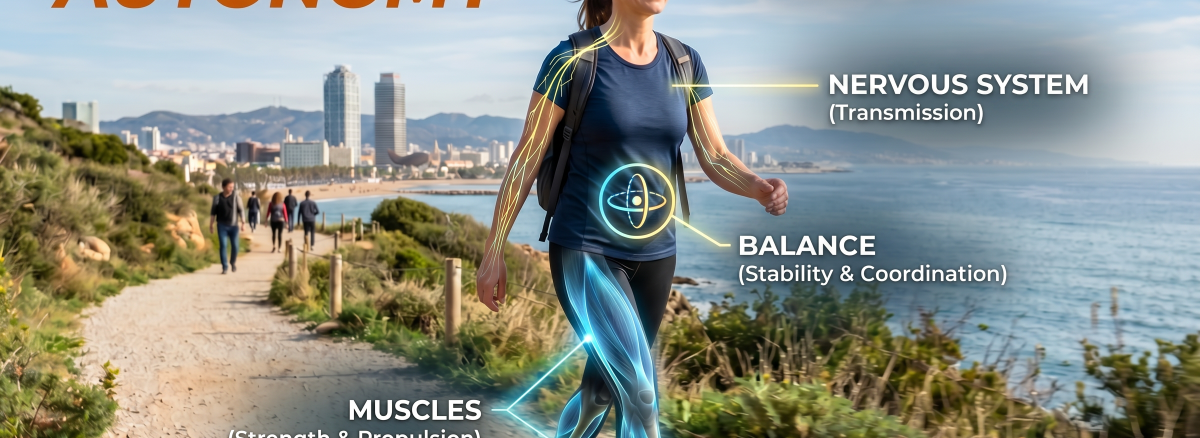
Walking is such a natural activity that we often forget the complexity behind every step. Yet gait relies simultaneously on the brain, spinal cord, peripheral nerves, muscles, joints, vision, and balance systems. When one of these systems is impaired, gait disorders can develop and have significant consequences for independence, social participation, and quality of life.
At Neuro-Concept, the team works daily with individuals experiencing walking difficulties resulting from neurological conditions, orthopedic impairments, or aging. Understanding these disorders is the first step toward effective management and rehabilitation.
What Is a Gait Disorder?
A gait disorder refers to any abnormal change in the way a person walks. It may present as:
- Reduced walking speed;
- Shortened step length;
- Instability or loss of balance;
- Asymmetry between the legs;
- Difficulty initiating or stopping walking;
- Excessive fatigue during mobility;
- Increased risk of falls.
These difficulties may appear gradually or suddenly, depending on their cause and progression.
The Main Causes of Gait Disorders
Aging
As we age, several physiological changes occur:
- Reduced muscle strength;
- Declining balance abilities;
- Slower reflexes;
- Diminished sensory performance.
These changes increase the risk of instability and falls, particularly in complex environments.
Musculoskeletal Conditions
Joint pain, osteoarthritis, orthopedic deformities, and muscle weakness can all affect gait.
People often adapt their walking pattern to avoid pain, which may lead to compensatory strategies that become inefficient or even detrimental over time.
Neurological Conditions
Neurological impairments are a common cause of locomotor disorders.
Some of the most frequent conditions include:
- Stroke;
- Parkinson’s disease;
- Multiple sclerosis;
- Spinal cord injuries;
- Traumatic brain injuries;
- Peripheral neuropathies;
- Cerebral palsy.
In these situations, the brain or nervous system is no longer able to efficiently transmit the information required to coordinate movement.

Consequences in Daily Life
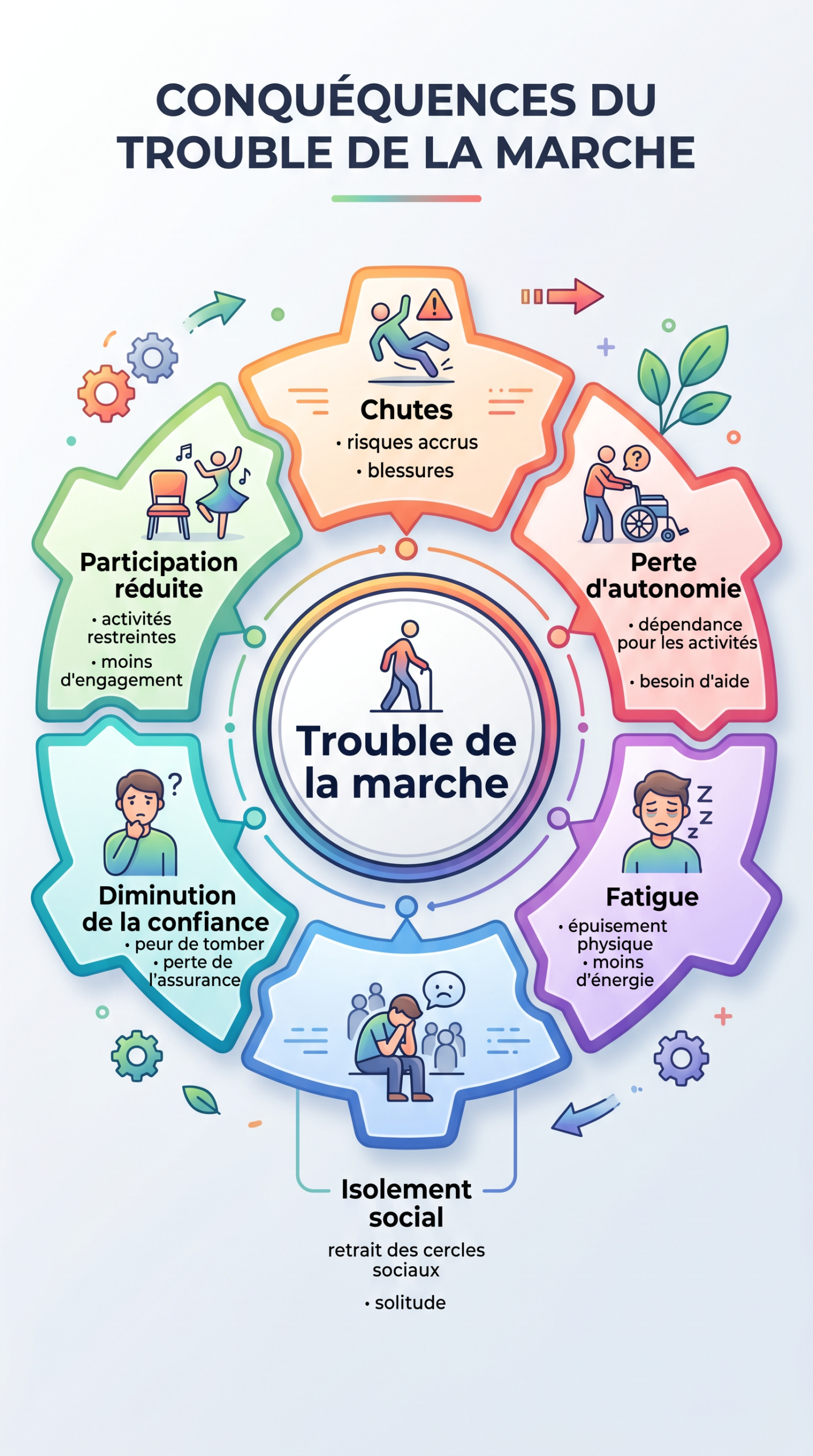
Loss of Independence – Mobility limitations can make it increasingly difficult to:
- Shop for groceries;
- Attend appointments;
- Participate in social activities;
- Maintain a regular physical activity routine.
Increased Risk of Falls – Falls are among the most common and concerning complications. They can result in:
- Fractures;
- Loss of confidence;
- Reduced mobility;
- Progressive physical deconditioning.
Psychological Impact – Fear of falling often leads individuals to restrict their activities. This vicious cycle promotes social isolation and contributes to a reduced quality of life.
The Importance of a Comprehensive Assessment
To implement an effective intervention, it is essential to identify the underlying mechanisms responsible for the gait disorder.
Assessment may include:
- Clinical observation;
- Postural analysis;
- Balance evaluation;
- Functional testing;
- Muscle strength assessment;
- Evaluation of walking endurance.
This process helps clinicians better understand an individual’s limitations and establish realistic, measurable goals.

Modern Approaches to Gait Rehabilitation
Intensive Task-Oriented Training
The brain possesses a remarkable ability to reorganize itself, known as neuroplasticity. To promote this adaptation, exercises must be specific, repetitive, and meaningful to the individual.
Gait training should therefore replicate real-life situations as closely as possible.
Balance Training
Improving postural control is a central component of rehabilitation.
Exercises may target:
- Weight shifting;
- Balance reactions;
- Dynamic stability;
- Management of external perturbations.
Strength Training
Adequate lower-limb strength is essential for safe and efficient walking.
Rehabilitation frequently focuses on:
- Quadriceps;
- Gluteal muscles;
- Plantar flexors;
- Core stabilizing muscles.
Rehabilitation Technologies
New technologies now offer particularly promising rehabilitation opportunities:
- Body-weight-supported treadmill training;
- Virtual reality;
- Robotic-assisted rehabilitation;
- Functional electrical stimulation (FES);
- Instrumented gait analysis.
These tools can increase both the intensity and precision of therapy sessions while enhancing patient engagement.
Gait Across the Lifespan: Why Adaptation Matters
Children
The primary goal is to support motor development and the acquisition of efficient walking patterns.
Interventions aim to promote:
- Exploration;
- Independence;
- Participation in school, sports, and social activities.
Exercises are often incorporated into play-based activities to stimulate motor learning and motivation.
Adults
For adults with neurological or orthopedic conditions, rehabilitation generally aims to restore or optimize locomotor abilities, improve endurance, and facilitate return to daily, professional, and recreational activities.
Interventions are based on exercises that are specific, intensive, and directly related to the individual’s functional goals.
Older adults
Management of gait disorders in older adults must take into account age-related physiological changes as well as the frequent presence of multiple health conditions.
Interventions focus not only on gait quality but also on:
- Balance;
- Muscle strength;
- Confidence in mobility;
- Fall prevention.
Environmental modifications and caregiver education may also play an important role in maintaining independence.

Functional Electrical Stimulation: A Promising Approach
Functional Electrical Stimulation (FES) aims to activate specific muscles at the appropriate moment during walking.
This technology is particularly useful for individuals with:
- Neurologically related muscle weakness;
- Foot drop following a stroke;
- Certain incomplete spinal cord injuries;
- Some chronic neurological conditions.
Beyond assisting movement, FES increases the repetition of functional movements and may promote neurological reorganization mechanisms. Several studies have also demonstrated benefits for walking speed, step symmetry, and motor function in specific neurological populations.
The Importance of an Individualized Approach
Every gait disorder is unique.
Two individuals with the same diagnosis may experience very different limitations depending on:
- Their level of function;
- Their environment;
- Their personal goals;
- Their overall physical condition.
For this reason, rehabilitation must be individualized and focused on the person’s actual needs.
Conclusion
Gait disorders represent a major challenge for many individuals living with neurological, orthopedic, or age-related conditions. Fortunately, current rehabilitation knowledge allows clinicians to deliver targeted and effective interventions.
Through comprehensive assessment, task-specific training, and the integration of innovative technologies such as Functional Electrical Stimulation, it is possible to improve mobility, reduce fall risk, and support a return to a more active and independent life.
References
- Xu Y, Hou QH, Russell SD, Bennett BC, Sellers AJ, Lin Q, Huang DF. Neuroplasticity in post-stroke gait recovery and noninvasive brain stimulation. Neural Regeneration Research. 2015;10(12):2072-2080. [pmc.ncbi.nlm.nih.gov], [researchgate.net]
- National Clinical Guideline for Stroke. Walking. UK National Clinical Guideline for Stroke, 2023. [strokeguideline.org]
- Camicioli R, Morris ME, Pieruccini-Faria F, et al. Prevention of Falls in Parkinson’s Disease: Guidelines and Gaps. Movement Disorders Clinical Practice. 2023;10(10):1459-1469. [pmc.ncbi.nlm.nih.gov], [movementdi….wiley.com]
- Li Y, Huang J, Wang J, Cheng Y. Effects of different exercises on improving gait performance in patients with Parkinson’s disease: a systematic review and network meta-analysis. Frontiers in Aging Neuroscience. 2025. [frontiersin.org]
- He W, Yaning L, Shaohong Y. Effect of electrical stimulation in the treatment of patients with foot drop after stroke: a systematic review and network meta-analysis. Journal of Stroke and Cerebrovascular Diseases. 2025. [strokejournal.org]
- Schifino G, Cimolin V, Pau M, et al. Functional Electrical Stimulation for Foot Drop in Post-Stroke People: Quantitative Effects on Step-to-Step Symmetry of Gait Using a Wearable Inertial Sensor. Sensors. 2021;21(3):921. [mdpi.com]