

- 1 June 2026
- The Neuro-Concept Blog
Neuroplasticity: How Physical Activity Transforms the Brain
By Dre Murielle Grangeon, PhD, Kin, Admin.A.
Neuroplasticity is the primary mechanism of recovery following damage to the central nervous system (CNS). Far from being passive, the brain has an experience-dependent capacity for adaptation. In this context, movement—when structured, repeated, and meaningful—acts as a powerful stimulus for neuronal reorganization. This article explores the mechanisms of neuroplasticity and the central role of physical activity in neurological recovery.
Traditionally, neurological recovery was seen as limited and largely determined by the severity of the lesion. However, advances in neuroscience have profoundly transformed this view.
Today, it is established that:
👉 the brain retains the ability to functionally reprogram itself throughout life.
This ability relies on neuroplasticity, a process directly modulated by experience, particularly movement.
Neuroplasticity: Definition and Mechanisms
Neuroplasticity refers to the ability of the nervous system to modify its structural and functional organization in response to internal or external stimuli.
Main Mechanisms
The key mechanisms involved include:
- Synaptic plasticity: strengthening or weakening of neuronal connections
- Long-term potentiation (LTP): consolidation of repeatedly activated circuits
- Cortical reorganization: redistribution of functions across different brain regions
- Recruitment of alternative networks
👉 These processes enable the brain to partially compensate for injury.
The Central Role of Movement
Movement is one of the most powerful stimuli for inducing neuroplasticity.
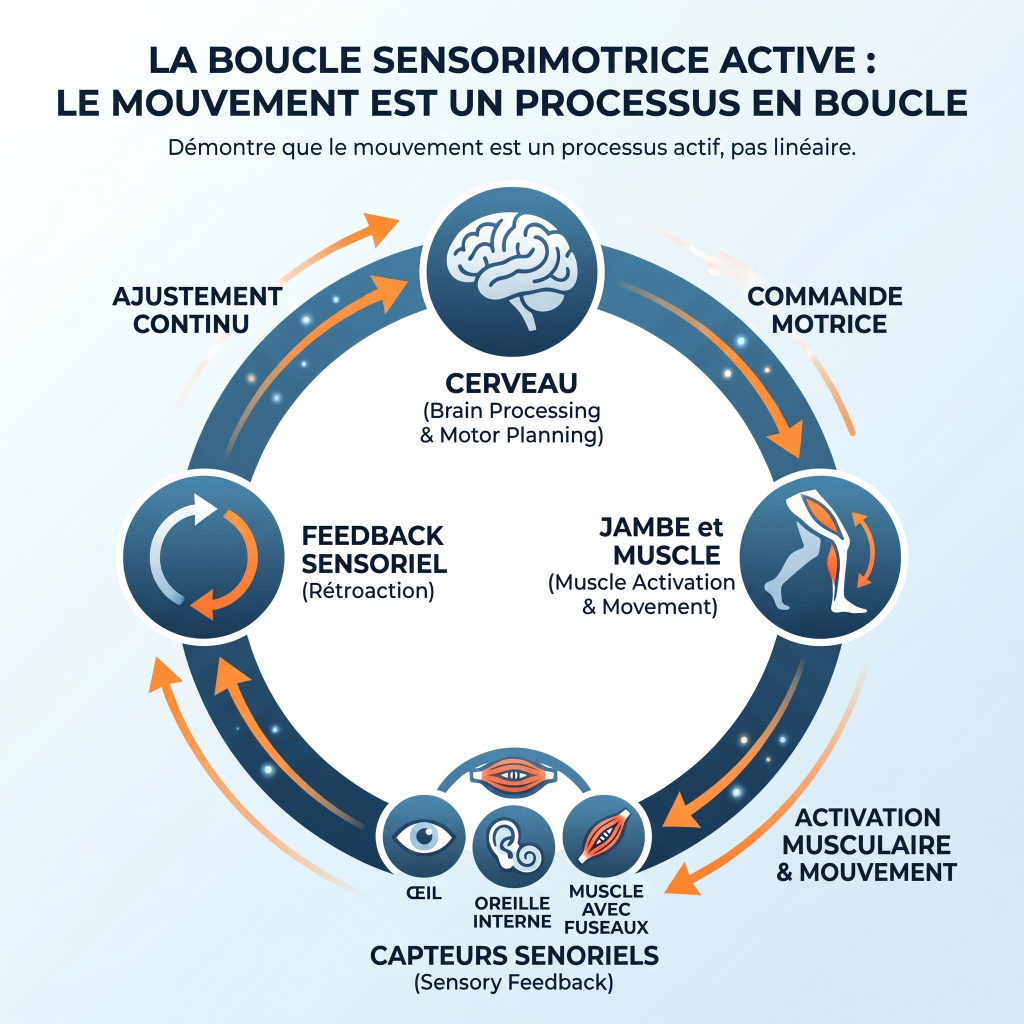
Each motor action generates:
- targeted neuronal activation
- sensory feedback (proprioception, vision, vestibular input)
- real-time adjustment
Thus:
👉 movement acts as a learning signal for the brain.
However, not all movements have the same effect.
Fundamental Principles of Activity-Induced Plasticity
| Principle | Definition | Neurophysiological Mechanism | Clinical Implication | Concrete Example |
|---|---|---|---|---|
| 🎯 Specificity | Adaptation is task-specific | Targeted activation of specific neural networks | Train the function you want to recover | Practicing walking to improve walking |
| 🔁 Repetition | Repetition consolidates learning | Synaptic strengthening (LTP) | Requires high practice volume | Repeating sit-to-stand transfers multiple times |
| ⚡ Intensity | A threshold of effort is needed | Increased circuit activation and release of neurotrophic factors | Favor sufficiently challenging exercises | Fast walking, intensified functional tasks |
| 🔄 Variability | Variation promotes adaptability | Recruitment of diverse neural networks | Enhances transfer to real-life situations | Changing surface, speed, environment |
| 🧠 Active engagement | Cognitive participation is essential | Activation of attentional and executive networks | Actively involve the patient | Giving a goal or functional task |
➡️ Neurological recovery depends on specific, repeated, and meaningful stimulation.
Limitations of Traditional Approaches
An approach focused solely on:
- muscle strengthening
- or mechanical correction
has major limitations:
- poor functional transfer
- lack of significant impact on the brain
- persistence of compensatory strategies
Thus:
👉 movement must be understood as a learning process, not merely physical exercise.
Exercises That Promote Motor Learning or Relearning

Effective interventions emphasize:
✅ Task-oriented exercises
- real walking rather than isolated exercises
- functional sit-to-stand transfers
✅ Feedback-based exercises
- use of visual or tactile feedback
- active correction by the patient
✅ Stimulating environments
- variation in surfaces
- integration of constraints
✅ Progressive exercises
- gradual increase in difficulty
- continuous adaptation
Implications for Practice
Intervention should target:
- specific activation of the nervous system
- motor learning
- meaningful repetition
The professional acts as:
👉 a facilitator of brain reprogramming
Conclusion
Neuroplasticity provides a powerful framework for understanding neurological recovery. Physical activity, when structured according to precise principles, becomes a central driver of brain transformation.
👉 Movement is not merely a consequence of recovery.
👉 It is a driving force behind it.
🔎 Perspective – Future developments in neurological rehabilitation are moving toward:
- evidence-based approaches
- stimulation technologies (e.g., functional electrical stimulation, assistive robotics, etc.)
- individualized recovery trajectories
🔜 Coming Next
In the next article, we will explore concrete intervention approaches in neurological rehabilitation, with practical strategies applicable in clinical settings.