


- 20 October 2026
- The Neuro-Concept Blog
Fatigue and Multiple Sclerosis: Is It Normal Exercise Fatigue or MS Fatigue?
By Dre Murielle Grangeon, PhD, Kin, C. Admin.
“I’ve started exercising more, but now I feel more tired.”
This is a common concern among people living with multiple sclerosis (MS). When fatigue follows a workout, it’s easy to assume that exercise must be making things worse.
But the reality is more complex.
Exercise naturally causes some degree of fatigue. In fact, feeling tired after physical activity is one of the body’s normal responses to exertion. Fatigue associated with MS, however, can be influenced by many different factors and isn’t always directly related to exercise.
So how can you tell the difference?
How do you know whether you’re simply tired because you’ve been active, or whether your fatigue is more related to MS?
There isn’t always a clear-cut answer, but understanding a few key principles can help.
Feeling Tired After Exercise Is Normal

In a culture where fatigue is often viewed as something negative, we sometimes forget that exercise is supposed to challenge the body.
When you walk farther than usual, lift weights, or complete a cardio workout, it’s normal to experience:
- a greater sense of effort;
- a temporary drop in energy;
- heavy or tired muscles;
- a need to recover afterward.
These reactions don’t necessarily mean you’ve overdone it.
In fact, physical activity remains strongly recommended for people with MS. Canadian guidelines suggest that aerobic exercise and strength training can help improve physical fitness, mobility, and even fatigue for many individuals living with the condition.
In other words, feeling tired after exercise does not automatically mean that exercise is harming your MS.
MS Fatigue Feels Different
The challenge is that MS-related fatigue often doesn’t feel like ordinary tiredness after physical activity.
People with MS may describe:
- overwhelming exhaustion that seems disproportionate to what they’ve done;
- low energy from the moment they wake up;
- difficulty concentrating or thinking clearly;
- a sense that their brain is “slowing down”;
- a noticeable decline in their abilities as the day goes on.
This fatigue can affect both physical and cognitive function. Some people may be able to walk without major difficulty but lack the energy needed to work, follow a complicated conversation, or stay focused for extended periods.
That’s why two people can perform exactly the same activity yet have completely different experiences.
A Common Mistake: Assuming Every Episode of Fatigue Is Caused by MS
When you’re diagnosed with a neurological condition, it’s understandable to view every symptom through that lens.
However, fatigue is rarely that simple.
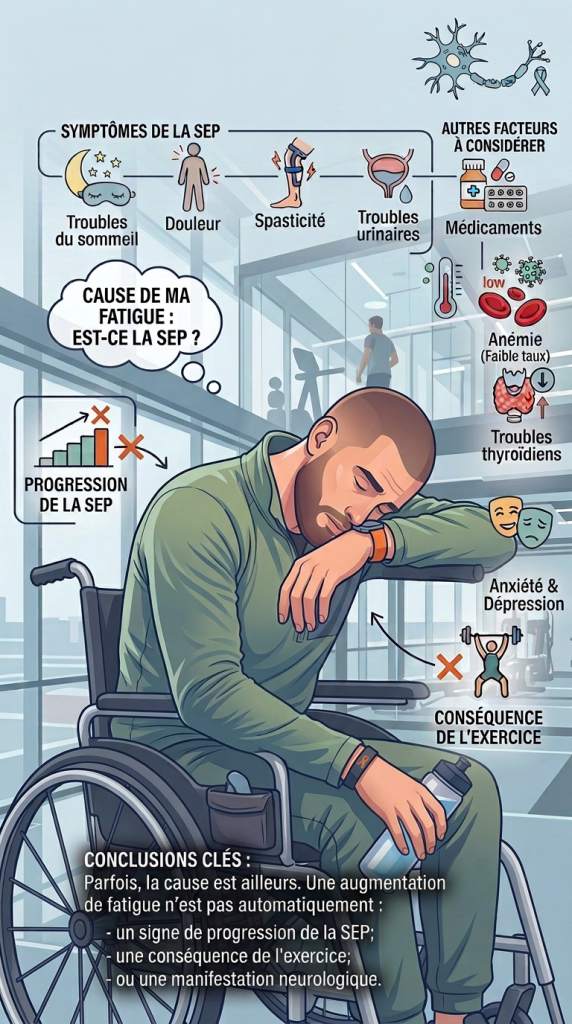
Clinical guidelines remind healthcare professionals not to assume that all fatigue in people with MS is caused by the disease itself. Other contributors may include:
- poor sleep;
- pain;
- spasticity;
- bladder symptoms;
- certain medications;
- infections;
- anemia;
- thyroid disorders;
- anxiety;
- depression.
In practical terms, a sudden increase in fatigue is not automatically:
- a sign that MS is progressing;
- a consequence of exercise;
- or even a neurological symptom.
Sometimes the explanation lies elsewhere.
Ask a Better Question
Rather than asking:
“Am I tired?”
Try asking:
“How does my fatigue change before, during, and after exercise?”
This simple shift in perspective can provide much more useful information.
Before Exercise
How do you feel before you start?
If you’re already extremely fatigued first thing in the morning, your workout is unlikely to be the sole cause.
During Exercise
Does the fatigue increase gradually as the effort becomes more demanding?
If so, that’s generally a normal and expected response to physical activity.
After Exercise
Ask yourself:
- Can you return to your usual activities afterward?
- How does the rest of your day go?
- Are there specific activities that consistently leave you feeling drained longer than others?
The goal isn’t to compare yourself to anyone else. It’s to understand your own pattern of response to exercise.
Don't Forget About Heat
For many people with MS, heat can play a significant role.
Even a small increase in body temperature can temporarily worsen symptoms such as:
- fatigue;
- weakness;
- cognitive difficulties;
- other neurological symptoms.
These changes often improve once the body cools down.
As a result, a workout performed:
- in a warm environment;
- during a heat wave;
- or at a higher intensity,
may trigger more symptoms than the same workout performed under cooler conditions.

Could Deconditioning Be Part of the Problem?
When fatigue is a constant challenge, cutting back on activity can seem like the obvious solution. Sometimes a temporary reduction in activity is necessary.
However, prolonged inactivity can lead to deconditioning, meaning a decline in physical fitness.
When that happens, everyday tasks begin to require more effort. Climbing stairs, carrying groceries, or even walking short distances can feel more exhausting because you’re working closer to your physical limits.
Deconditioning doesn’t fully explain fatigue in MS, but it can contribute to the problem.
That’s why rehabilitation is usually not about avoiding activity altogether or pushing yourself endlessly.
The goal is to find the right amount of activity for you.
The Goal Isn't to Never Feel Tired
This may be the most important point of all.
In rehabilitation, the objective is not to eliminate every trace of fatigue after exercise. Instead, the goal is to determine:
- which activities are helpful;
- what level of intensity is appropriate;
- which symptoms should be monitored;
- how recovery can be optimized;
- how to maintain meaningful daily activities.
Aerobic exercise, strength training, and balance exercises can all play a role in managing fatigue in MS. As a result, experiencing some fatigue does not necessarily mean your exercise program is inappropriate.
When Should Fatigue Raise Concern?
A reassessment may be warranted if:
- your fatigue suddenly feels different;
- symptoms become much more severe than usual;
- new symptoms appear;
- routine activities become noticeably harder;
- recovery takes significantly longer than it typically does.
In these situations, it’s worth looking more closely rather than assuming the issue is simply exercise-related or “just MS.”
Takeaway
Fatigue after exercise and fatigue related to multiple sclerosis are not completely separate experiences.
For many people, both can exist at the same time.
So the question isn’t:
“Does exercise make me tired?”
Because the answer is often yes.
A more useful question is:
“How does my body respond to this activity, and how does it affect my ability to function?”
Exercise should not be viewed as the enemy of fatigue in MS. When tailored to an individual’s abilities, it can help improve fitness, mobility, and certain aspects of fatigue itself.
The goal is not to avoid fatigue altogether. The goal is to understand which fatigue is expected, which deserves closer attention, and how to adjust activity in a way that supports your health, independence, and quality of life.
Key Takeaways
- Feeling tired after exercise is normal and not necessarily a cause for concern.
- Not all fatigue experienced by people with MS is caused by the disease itself.
- Heat, sleep, pain, medications, and many other factors can affect fatigue levels.
- Exercise remains recommended for many people living with MS when it is individualized and appropriately adapted.
- The aim of rehabilitation is not to eliminate fatigue completely, but to support function, participation, and quality of life.