

- 9 June 2026
- The Neuro-Concept Blog
Neurological Rehabilitation: Exercises, Motor Control, and an Effective Interdisciplinary Approach
By Dre Murielle Grangeon, PhD, Kin, Admin.A.
🔎 Summary
Rehabilitation of central nervous system (CNS) disorders is based on principles that differ from traditional physical health approaches. It involves not only the application of specific training strategies but also an integrated understanding of the patient’s neurological, functional, cognitive, and environmental dimensions.
This article provides a structured synthesis of effective intervention principles in neurology, while situating them within a global and interdisciplinary framework.
1. Introduction
Central neurological disorders fundamentally alter the organization of movement. The observed deficit is not merely a loss of muscular capacity, but an impairment of motor control and coordination mechanisms.
In this context, intervention cannot be limited to a mechanical restoration logic. It must be designed as a structured motor learning process aimed at functional reorganization of the nervous system.
2. Task-Oriented Training: The Foundation of Intervention
Neurophysiological Rationale
- Specific activation of neural networks involved in the task
- Use-dependent synaptic strengthening
- Improved transfer to activities of daily living
Clinical Implications
Exercise selection must be directly related to functional goals:
- Gait training to improve locomotion
- Transfer practice to enhance independence
- Object manipulation to restore upper-limb function
👉 The nervous system adapts based on the constraints imposed on it.
3. Muscle Strengthening and Motor Control: A Critical Distinction
Muscle Strengthening
- Aims to increase force production capacity
- Relevant in certain situations of deconditioning
Motor Control
- Relates to the spatiotemporal organization of movement
- Involves coordination, timing, and sensory integration
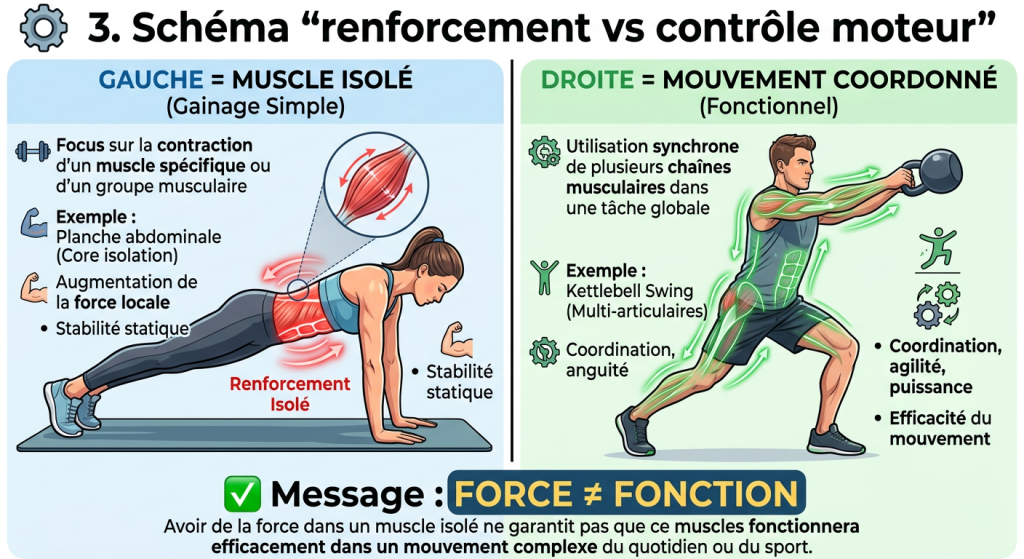
Clinical Implications
- Poor motor unit selection
- Impaired coordination
- Inefficient use of available resources
👉 Isolated strengthening therefore has limited impact if not integrated into functional tasks.
4. Exercise Structure and Progression
- Gradual
- Individualized
- Function-oriented
To promote:
- Automation
- Adaptation
- Functional transfer
- Sitting control
- Stable standing
- Reduced support
- Introduction of instability
- External perturbations
- Assisted walking
- Independent walking at low speed
- Increased load and speed
- Environmental variation
- Integration of cognitive tasks (dual-task)
5. Key Parameters of Intervention
🔁 Volume
- Frequency and number of repetitions
- Essential for consolidating learning
🔄 Complexity
- Task variability
- Cognitive demands
- Environmental constraints
👉 Promotes adaptability and transferability
⚡ Intensity
- Level of effort required
- Degree of nervous system activation
Sufficient intensity is necessary to induce neuroplastic changes.
In this context, certain technologies (functional electrical stimulation, robotics, virtual reality) can facilitate outcomes by increasing:
- Training dosage
- Neuromuscular activation
- Quality of sensory feedback
👉 These tools should be considered amplifiers, integrated within structured clinical reasoning.
6. Common Errors in Clinical Practice
Certain mistakes significantly limit intervention effectiveness:
- Excessive focus on muscle strengthening
- Exercises disconnected from functional goals
- Insufficient practice volume
- Inadequate progression
- Low patient engagement
👉 These factors compromise motor learning consolidation.
7. Limitations of an Exercise-Only Approach
Even when properly structured, an exercise program alone is insufficient to optimize recovery.
Functional performance is influenced by:
- Cognition
- Fatigue
- Motivation
- Environment
👉 An integrated approach is necessary.
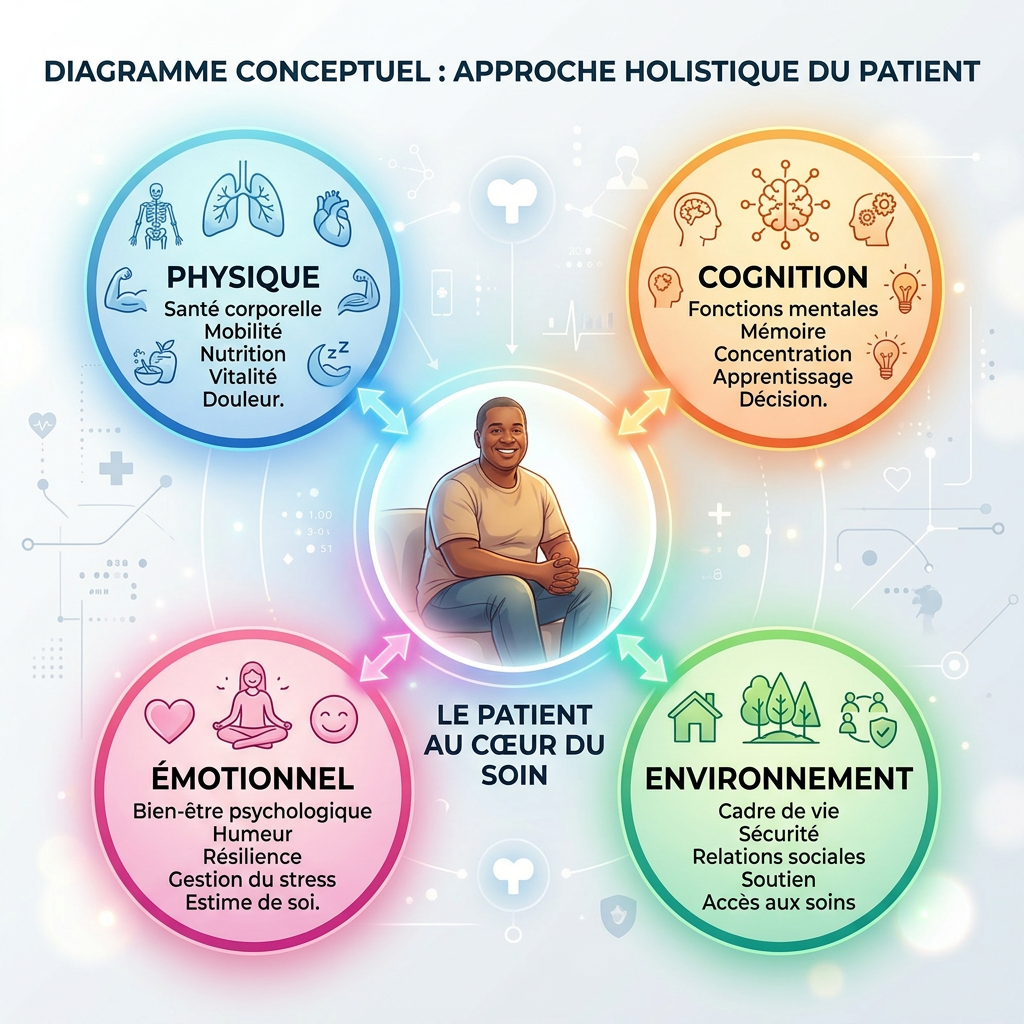
8. A Global, Person-Centered Approach
The neurological patient must be considered a complex system.
Dimensions to Consider:
- Neurological
- Physical
- Cognitive
- Psychosocial
- Environmental
👉 Recovery depends on the interaction of these factors.
9. Interdisciplinary Approach
| Discipline | Contribution |
|---|---|
| Physiotherapy | Motor recovery |
| Occupational Therapy | Functional independence |
| Kinesiology | Physical conditioning |
| Neuropsychology | Cognition |
| Medicine | Overall management |
| Speech Therapy | Communication |
10. Coordination and Continuity of Care
Effective management relies on:
- Shared goals
- Interprofessional communication
- Continuity of interventions
👉 Lack of coordination is a major limiting factor.
11. Role of Lifestyle Factors
Extraclinical factors directly influence recovery:
- Sleep: learning consolidation
- Stress: modulation of brain plasticity
- Daily activity: continuous stimulation
👉 These must be integrated into the therapeutic strategy.
12. Individualization of Intervention
Each patient presents:
- A specific impairment
- A distinct functional profile
- A unique environment
👉 Intervention must be:
- Adapted
- Evolving
- Centered on meaningful goals
13. Role of the Clinician
The professional acts as:
- A designer of motor learning
- A constraint modulator
- An integrated member of a care network
👉 Their role goes beyond prescribing exercises:
they build a recovery trajectory.
🎯 Key Message
➡️ Working in neurology requires precision, adaptation, and individualization, within a global and coordinated approach.
✅ Conclusion
Effective neurological rehabilitation relies on a dual requirement:
- Precise intervention grounded in motor control principles
- Integration within a global, person-centered approach
👉 The goal is not only to restore function, but to enable durable reorganization of movement in the patient’s real-life context.
🔜 Coming Next
The interdisciplinary approach is essential in neurology, but its implementation raises important issues related to scope of practice and regulatory frameworks.
In the next article, we will explore the concept of integrative health in neurology, balancing clinical needs with professional realities.