

- 27 April 2026
- The Neuro-Concept Blog
Neuroplasticity: What Science Really Says (and What Popularization Exaggerates)
By Dre Murielle Grangeon, PhD, Kin, Admin.A.
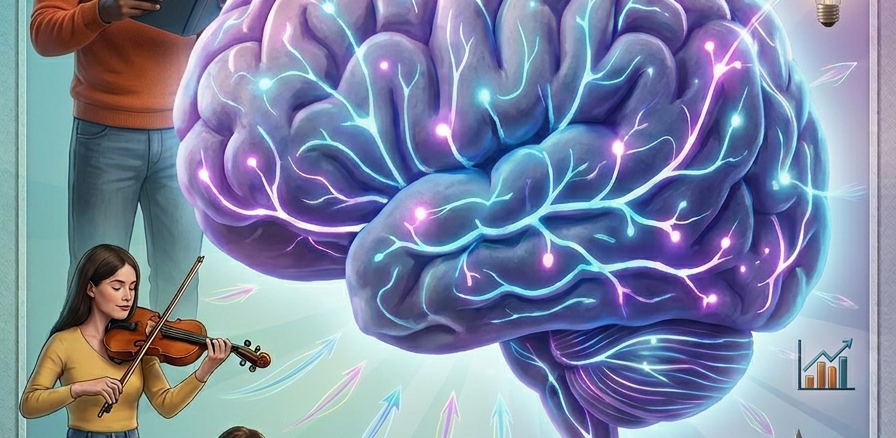
Neuroplasticity has become an omnipresent buzzword. It is invoked to explain learning, healing, psychological resilience, rehabilitation, creativity—and sometimes to suggest that one simply needs to “reprogram the brain” to transform one’s life. Popular books, conferences, professional trainings, and social media enthusiastically embrace the concept, particularly in Quebec, where discourse surrounding human potential and individual autonomy is deeply rooted.
Yet a significant gap remains between what neuroscience actually demonstrates and what certain forms of popularization claim. This gap is not so much the result of a science-versus-popularization opposition as it is the outcome of excessive simplification of complex phenomena—simplification that ultimately turns a rigorous concept into a slogan.
| What science says | What popularization exaggerates |
|---|---|
| Lifelong plasticity | Unlimited plasticity |
| Change under constraints | Change through sheer willpower |
| Indirect processes | Direct conscious control |
| Variable outcomes | Implicit promise |
1. What Science Really Means by Neuroplasticity
In neuroscience, neuroplasticity refers to the capacity of the nervous system to change in response to experience, learning, the environment, or pathology. These changes can take several forms:
- adjustment of synaptic strength;
- creation or elimination of connections;
- functional reorganization of existing neural networks;
- and, in very limited contexts, neurogenesis.
This is neither a recent discovery nor a marginal phenomenon. Plasticity is a central principle of brain function, documented for decades in both children and adults.
👉 The brain is not a fixed organ: it is dynamic by nature.
2. Neuroplasticity Throughout Life… but Not Without Constraints
Science is now clear on a fundamental point: neuroplasticity exists throughout life. Contrary to a still-persistent belief, it does not “switch off” in adulthood. The human brain retains, even into advanced age, a genuine capacity to change in response to experience, learning, and certain therapeutic interventions.
Acknowledging this lifelong plasticity does not mean that all forms of brain change are equally accessible, rapid, or extensive at every age. Contemporary research instead shows that plastic mechanisms vary depending on development, biological context, and physiological constraints.
Certain neural reorganizations—particularly those involving large-scale remapping of sensory or motor representations—are more likely and faster during childhood. In adulthood, plasticity remains clearly active, but it is often more specific, slower, and more dependent on conscious attention, repetition, and the therapeutic environment.
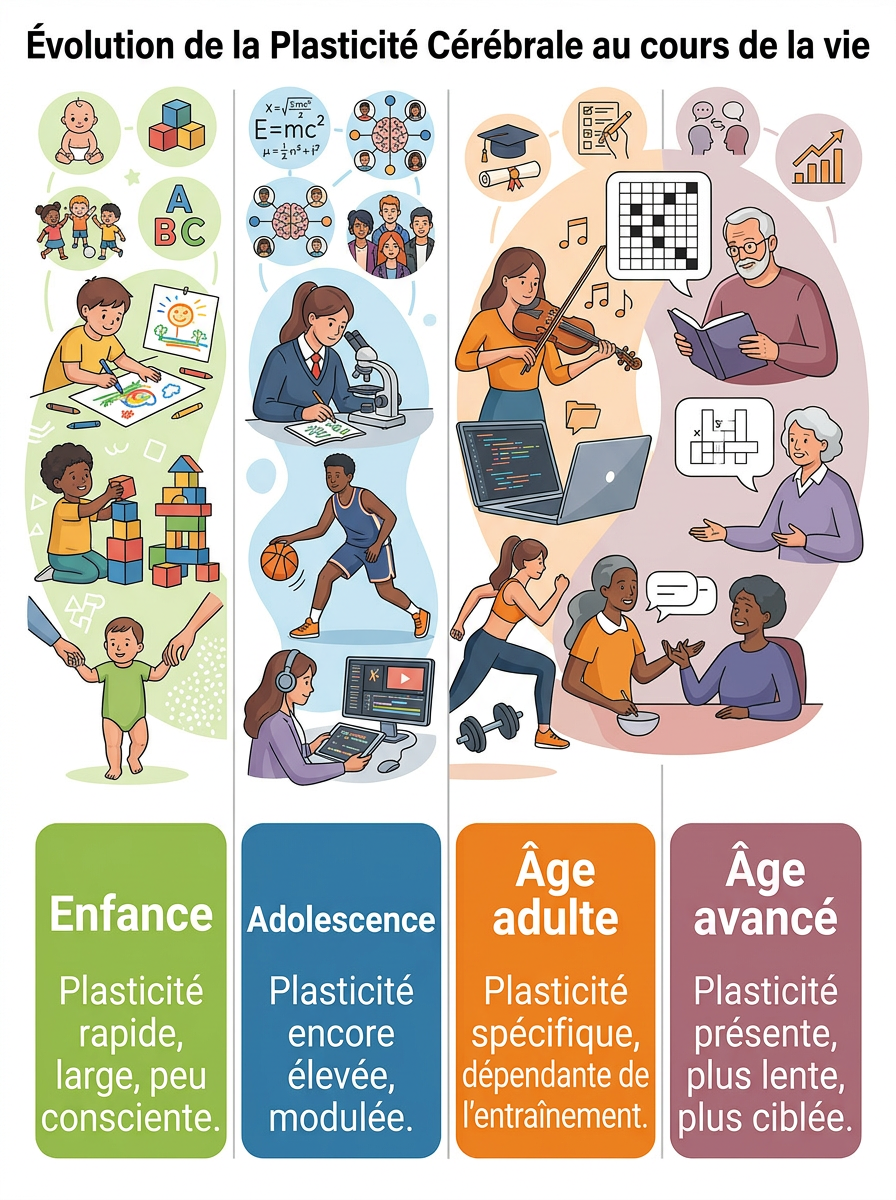
In adults, plastic changes rely more heavily on:
- fine modulation of existing networks;
- functional redistribution of brain activity;
- explicit and implicit learning;
- attentional and motivational engagement.
Plasticity therefore makes change possible—it does not guarantee its speed, magnitude, or unlimited extent.
3. Functional Neurological Disorders: When Plasticity Is Central
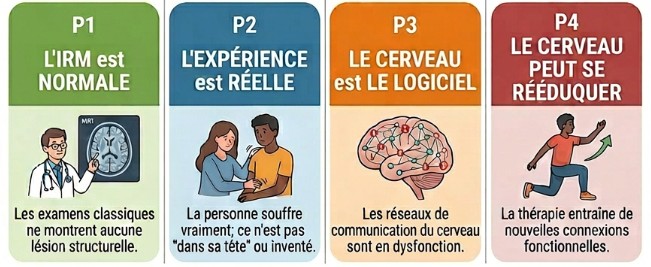
Functional neurological disorders (FND) provide a particularly clear illustration of this complexity. In these conditions, there is no structural lesion of the nervous system, but it would be scientifically incorrect to conclude that “the brain is functioning normally.” Neuroimaging studies instead reveal measurable dysfunctions in brain networks, particularly those involved in motor control, attention, sensorimotor prediction, and threat evaluation.
Symptoms are therefore real, neurological, and involuntary: the brain is functionally “derailed.”
In this context, neuroplasticity plays a central role. These dysfunctional networks can reorganize, and insight into the mechanisms underlying the disorder often constitutes a major therapeutic lever. Understanding that symptoms are real but reversible—and linked to functional brain mechanisms—can shift the patient’s focus of attention, reduce perceived threat, and facilitate the gradual recovery of impaired functions.
That said, even in FND—where functional plasticity is particularly harnessable—recovery is neither instantaneous nor purely voluntary. Insight works because it is embedded in a structured therapeutic process: gradual re-exposure, de-automation of hypercontrol, and sometimes physiotherapy, kinesiology, occupational therapy, or specialized psychotherapy. It is not a simple intellectual realization that alone suffices to “reprogram” the brain.
4. Where Popularization Tends to Exaggerate
This is precisely where certain forms of popularization drift into excess. In the Quebec public sphere, neuroplasticity is sometimes invoked to support:
- motivational discourse,
- pseudo-therapeutic narratives,
- coaching approaches,
- or alternative health practices.
One frequently hears claims such as:
“The brain does not distinguish between imagination and reality.”
“Changing your thoughts directly changes your reality.”
“Limits are neurological illusions.”
These statements draw inspiration from legitimate scientific findings but extrapolate them well beyond what science can support. They conflate brain plasticity with direct voluntary control over the brain and turn a probabilistic, indirect process into an implicit promise of unlimited transformation.
5. Why These Exaggerations Are Problematic
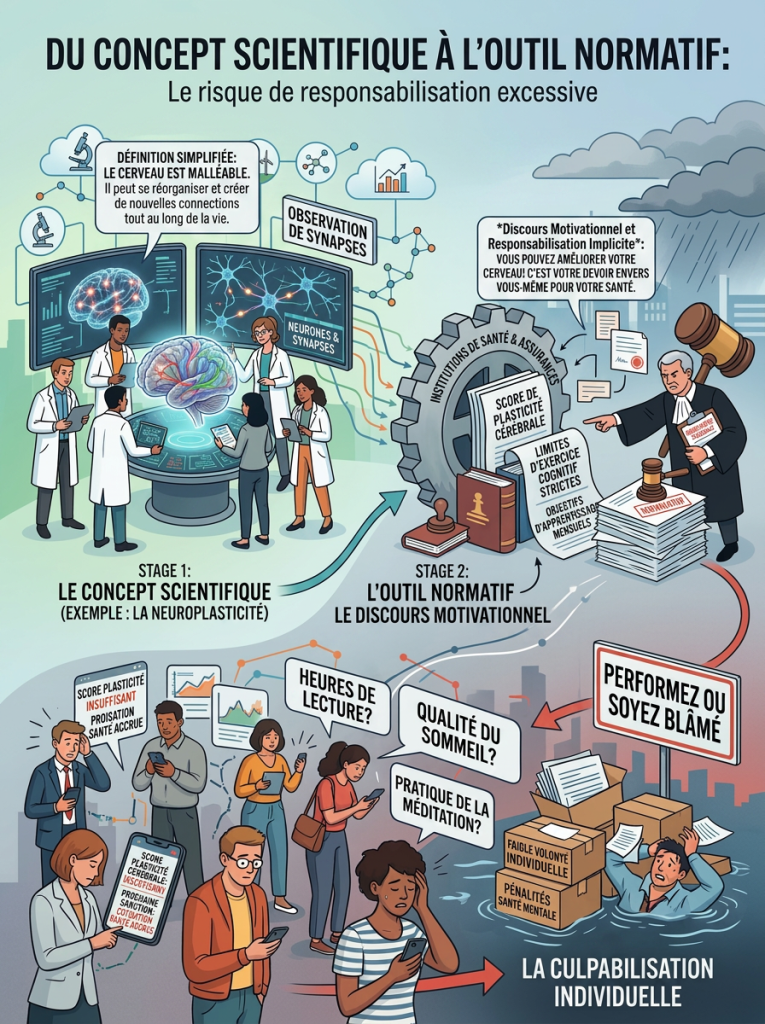
Even when driven by positive intentions, such simplifications can have harmful effects:
- blaming patients who do not recover despite sustained effort;
- legitimizing practices that lack scientific grounding;
- weakening trust in evidence-based care;
- blurring the distinction between therapeutic hope and implicit promise.
Neuroplasticity does not abolish illness, suffering, or disability. It offers real possibilities for change—but these possibilities are variable, unequal, and context-dependent.
6. Toward More Rigorous (and More Human) Popularization
Criticizing these excesses does not amount to denying the power of neuroplasticity. On the contrary, it allows us to respect its full complexity.
Responsible popularization should:
- clearly distinguish what is demonstrated from what remains hypothetical;
- acknowledge biological and contextual constraints;
- avoid language of promises or miracles;
- avoid placing the full responsibility for change on the individual.
✦ The brain changes throughout life.
✦ Insight can be therapeutic, sometimes decisive.
✦ But brain change is neither automatic nor entirely governed by willpower.
Conclusion
Neuroplasticity is one of the most fascinating concepts in contemporary neuroscience. But when it is turned into a slogan or an ideological tool, it loses its scientific rigor—and sometimes its humanity.
Perhaps the message most faithful to current science would be this:
the brain is capable of change throughout life, sometimes in remarkable ways, but always under constraints. Acknowledging these limits is not a setback—it is a condition for rigor and respect for the people concerned.