

- 5 April 2026
- kinesiology, Neurology, Rehabilitation explained, The Neuro-Concept Blog
Robotics at the Heart of a Continuum: From Rehabilitation to Neurological Training
By Dre Murielle Grangeon, PhD, Kin, Admin.A.
In Rehabilitation: Facilitating Movement and Supporting Recovery
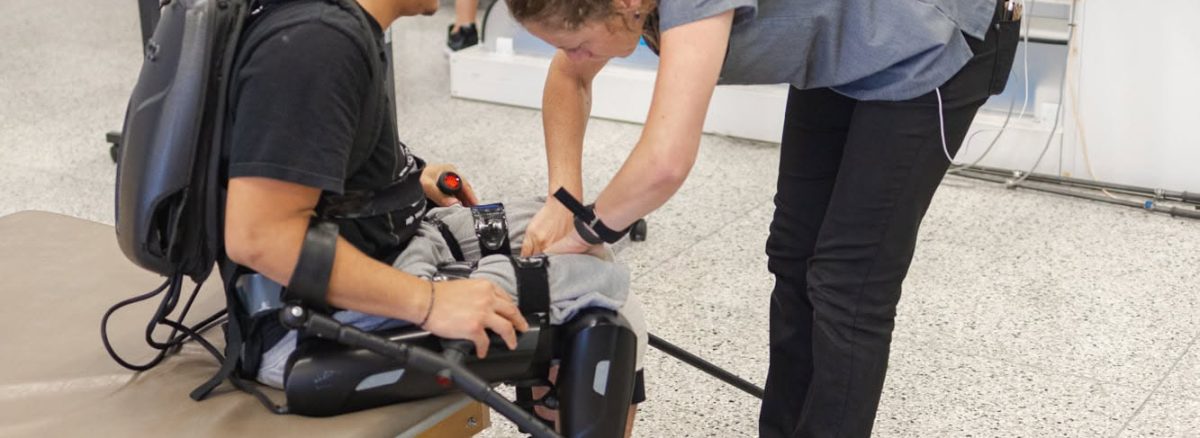
In the context of neurological rehabilitation, robotics primarily serves as a facilitation tool. It enables access to movement when this is limited by significant motor impairment, pronounced fatigue, or increased safety risks.
For individuals in the acute or subacute phase—for example following a stroke, an incomplete spinal cord injury, or a traumatic brain injury—robotic devices can:
- support a limb that is unable to move actively through its full range of motion;
- enable the early repetition of a functional movement;
- structure gait or upper-limb training within a safe environment.
In this setting, robotics mainly helps increase the dose and repetition of practice, two key determinants of neurological recovery. However, it does not replace clinical assessment or therapeutic reasoning. Its effectiveness depends closely on how well it is integrated into a comprehensive rehabilitation plan.
A central challenge remains the patient’s active participation. Excessive or poorly calibrated assistance can limit motor engagement, error, and adaptation—elements that are essential to motor learning. In rehabilitation, robotics should therefore be used in a transitional, critical manner and be regularly reassessed.
After Rehabilitation: Reorienting Robotics Toward Neurological Training
When formal rehabilitation ends, many individuals continue to experience persistent limitations without benefiting from intensive therapeutic follow-up. It is at this point that robotics takes on a different role.
In a post-rehabilitation context, the primary objective is no longer to make movement possible, but to train it, strengthen it, and optimize it. The approach shifts from facilitation to neurological training, generally led by kinesiologists.
Robotics then becomes a tool to:
- precisely dose load, speed, or task complexity;
- introduce resistance, variability, or targeted constraints;
- quantify progress and support long-term training.
For individuals with chronic neurological conditions (long-standing stroke, stable multiple sclerosis, Parkinson’s disease), these technologies make it possible to address parameters that are often difficult to target otherwise: walking endurance, symmetry, fine coordination, movement consistency, and neurological fatigue.
One Technology, Different Intentions
What fundamentally distinguishes rehabilitation from neurological training is not the population or the technology, but the intent and the framework of intervention.
- In rehabilitation, robotics supports a therapeutic process guided by clinical assessment and recovery-oriented goals.
- In neurological training, it supports a functional progression approach—without diagnosis or treatment—focused on maintaining and improving residual capacities.
From this perspective, robotics becomes a bridge between disciplines, provided that roles are clearly defined and that the transition from rehabilitation to training is well structured.
An Integrated and Realistic Vision
Thinking of robotics as part of a continuum helps avoid two common pitfalls:
- the overuse of technology in rehabilitation when it offers no real added value;
- the underuse of robotics after rehabilitation, despite ongoing needs.
Used at the right time, by the right professional, and with the right intention, robotics can support not only recovery but also the long-term sustainability of functional gains.
At Neuro‑Concept, this approach reflects a clear vision: technology is not an end in itself, but an evolving tool capable of supporting individuals well beyond rehabilitation, toward active and lasting autonomy.